Cybersecurity threats are only getting faster and more damaging. In 2025, organizations are seeing attacks evolve in sophistication, and the speed at which breaches unfold is a real concern for defenders.
According to IBM’s Cost of a Data Breach Report 2025, the average global cost of a data breach climbed to $4.44 million, highlighting how serious and costly these incidents have become for businesses worldwide.
With attackers constantly improving their techniques, security teams need tools that give them deeper visibility and faster investigative power. That’s where Palo Alto Networks Cortex XDR shines, offering unified insights across endpoints, alerts, logs, and cases.
If you want to sharpen how you detect, investigate, and respond to threats, the Cortex XDR: Investigation and Analysis course is a solid next step. It gives you hands-on skills in forensics, XQL, and automation in just two days.
Why Take the Cortex XDR: Investigation and Analysis Course?
The Cortex XDR: Investigation and Analysis course is designed for security professionals who want to do more than just react to threats. It’s for those who want to lead investigations, uncover root causes, and streamline response with confidence.
1. Gain practical skills in incident investigation
You will learn how to analyse security alerts, investigate incidents using the causality chain, and examine endpoint activity to uncover threats hiding in plain sight. These are essential capabilities for anyone working in a SOC or response team.
2. Master XQL to query logs like a pro
The course introduces you to XDR Query Language, allowing you to explore logs across endpoints and cloud sources. you will be able to quickly extract insights that would otherwise take hours to uncover.
3. Learn how to automate investigations at scale
You will explore Cortex XDR’s automation features that reduce manual workload and improve consistency in how cases are handled. This helps your team move faster and stay focused on high-priority threats.
4. Bridge the gap between alerts and action
By understanding how to use dashboards, reports, and case management tools effectively, you can turn alerts into informed action. This course equips you to respond with greater accuracy and clarity.
Whether you’re new to XDR or looking to deepen your expertise, this course gives you a solid foundation to build smarter, faster investigation workflows.
If this course does not seem like the right next step, filling the form below helps narrow down more appropriate Palo Alto Networks training options.
Cortex XDR: Investigation and Analysis Overview
The Cortex XDR: Investigation and Analysis course is a focused, two-day training program built to help cybersecurity professionals strengthen their investigative capabilities using Palo Alto Networks’ Cortex XDR platform. Through a blend of instructor-led sessions and hands-on simulations, participants learn how to investigate cases, run deep forensic analysis, query logs with XQL, and automate common SOC workflows.
Here’s a quick overview of what the course offers:
| Feature | Details |
| Course Duration | 2 days |
| Delivery Format | Instructor-led lectures and hands-on labs |
| Course Level | Intermediate |
| Target Audience | SOC Analysts, CERT and CSIRT Members, XDR Analysts, Incident Responders, Threat Hunters |
| Prerequisites | Cybersecurity fundamentals and investigation experience with security tools |
| Platform Support | Cortex XDR |
| Training Credits | 20 |
Enrolling in the Cortex XDR: Investigation and Analysis Course
The Cortex XDR: Investigation and Analysis course is delivered globally through Palo Alto Networks’ Authorized Training Partners (ATPs), including Datacipher. It’s offered regularly throughout the year, making it accessible to professionals across regions.
There are two main ways to enroll:
You can browse all upcoming sessions by visiting the official ATP course schedule portal. From there, you can filter results by location, time zone, language, and preferred format. The portal provides access to sessions from all recognized training partners.
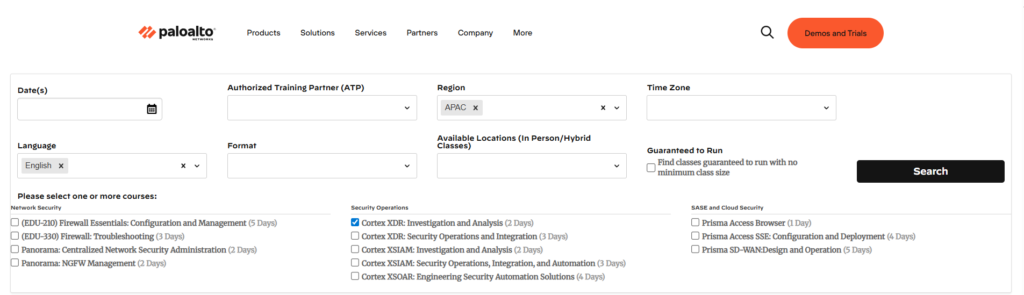
Source – Palo Alto
For learners based in APAC or those looking for flexible options, registration is also available directly through our website. At Datacipher, we offer both online and on-site sessions, along with team-based bookings. You can reach out to our team anytime for guidance.
Once you’ve selected the session that fits your schedule, simply follow the registration steps and complete the payment through either the Palo Alto portal or the ATP’s website.
Now that you know how to enroll, let’s look at who this course is meant for and what skills are expected before you join.
Who Is This Course Designed For?
The Cortex XDR: Investigation and Analysis course is built for professionals involved in identifying, investigating, and managing security incidents. If your role requires you to handle alerts, perform forensic analysis, or optimize investigation workflows, this training is a strong fit.
This includes:
- Security Operations Center Analysts
- Incident Response and CSIRT Team Members
- Threat Hunters and Detection Engineers
- XDR Specialists and Endpoint Security Analysts
- Security Consultants and Technical Pre-Sales Engineers
Prerequisites
To get the most value from this course, participants should have:
- A working knowledge of cybersecurity fundamentals and incident handling
- Hands-on experience using tools like SIEMs, EDRs, or other investigation platforms
- The ability to interpret logs and alerts across endpoint or network environments
These baseline skills will help you fully engage with Cortex XDR’s advanced querying, analysis, and case management features during the training.
What You Will Learn from the Cortex XDR: Investigation and Analysis Course
If you are part of a security team responsible for investigating alerts, analyzing incidents, or managing endpoint security, this course is designed to give you full command of the Cortex XDR platform. Here’s what you will be able to do after completing the training:
1. Investigate Complex Alerts with Confidence
You will learn how to dissect alerts and understand the chain of events that led to them. Using the causality view and endpoint telemetry, you will be able to identify root causes quickly and accurately.
2. Use XQL to Extract Security Insights from Raw Data
The course teaches you how to write XQL queries that let you search across logs, filter results, and pinpoint malicious activity in minutes. This skill is key for threat hunting and post-incident reviews.
3. Apply Forensic Techniques in Real-Time Scenarios
You will work with forensic features built into Cortex XDR to examine endpoint behavior, file activity, and vulnerabilities. These skills help you investigate lateral movement, persistence methods, and data exfiltration attempts.
4. Automate Repetitive Investigation Tasks
Learn how to use platform automation to streamline common investigation workflows. Whether it’s assigning cases, tagging incidents, or escalating findings, you will reduce manual effort and improve response speed.
5. Manage Cases and Track Investigations from Start to Finish
The course shows you how to group related alerts, manage them as cases, and maintain an audit trail. You will walk away knowing how to organize investigations in a way that supports collaboration and reporting.
For a detailed breakdown of each module, lab exercise, and course objective, you can read the full course datasheet.
Now that you know what this course will equip you with, it’s the perfect time to take the next step and secure your spot.
Advance Your Cortex XDR Skills with Datacipher Education Services
Datacipher is recognized across the APAC region as a trusted Palo Alto Networks Authorized Training Partner, delivering advanced cybersecurity education that translates directly into real-world capability.
Here’s why professionals and enterprise teams turn to us for Cortex XDR training:
1. Deep Knowledge Backed by Practical Experience
Our instructors are not only certified experts but also seasoned practitioners who’ve worked on Cortex XDR deployments in real operational environments. They bring both the technical depth and the context to help you apply what you learn.
2. Training That Fits Your Schedule
We offer flexible training options including online and in-person sessions, with timings that can be adapted for individuals or full teams. Whether you’re enrolling solo or as part of a group, our delivery approach is designed to suit your needs.
3. Support That Goes Beyond the Classroom
From the moment you express interest to the day you complete the course, and even beyond, our team provides guidance at every step. We’re here to answer questions, assist with logistics, and ensure your learning experience is smooth and impactful.
Here’s what our learners are saying:
“Thanks a lot for such informative sessions on Palo Alto. I really appreciate your teaching approach; every chapter was explained in detail, and all our questions were addressed clearly. I’d love to join your class again in the future.”
– Atharva Jamkar, Accenture
If you’re ready to take your investigation and response skills to the next level with Cortex XDR, we’re here to help you get there. Contact us today to find the next available session and reserve your seat.
Frequently Asked Questions
1. Do I need programming skills to take the Cortex XDR: Investigation and Analysis course?
No programming background is required. The Cortex XDR: Investigation and Analysis course focuses on investigative techniques, XQL querying, and platform usage. As long as you’re familiar with cybersecurity fundamentals and comfortable reviewing alerts or endpoint activity, you will be able to follow the training and complete the labs successfully.
2. What kind of real-world scenarios are covered in the Cortex XDR: Investigation and Analysis course?
You will work through practical use cases such as alert correlation, endpoint threat tracking, and forensic analysis. The Cortex XDR: Investigation and Analysis course includes labs that simulate real incidents, giving you the confidence to handle similar situations in a live SOC or response environment.
3. How does the Cortex XDR Investigation and Analysis course support my career growth?
This course builds critical skills for security analysts, incident responders, and threat hunters. Mastery of Cortex XDR is increasingly in demand, and completing the course helps you move into advanced roles in detection and response or prepare for related certifications.
4. Can Palo Alto Networks training credits be used for the Cortex XDR: Investigation and Analysis course?
Yes, Palo Alto Networks training credits are accepted for the Cortex XDR Investigation and Analysis course. You can apply available credits during registration through the training portal or contact Datacipher for help in processing the enrollment using your credit balance.